Islamic Date Converter

Gregorian and Hijri civil calendar conversion

Islamic Date Converter

Convert Gregorian dates to Islamic civil Hijri dates, or convert Hijri dates back to Gregorian dates with a deterministic arithmetic calendar.

Use YYYY-MM-DD format.

Use Hijri YYYY-MM-DD format.

Result

1448-02-13
Gregorian 2026-07-29
Hijri civil Safar 13, 1448 AH
Reference JDN 2461251

This uses a deterministic arithmetic Islamic civil calendar. Local moon-sighting dates can differ by location or authority.

Secondary converters

Focused Islamic calendar tools

Open dedicated tools for reverse lookup, Ramadan ranges, and Eid dates using the same deterministic civil Hijri calendar.

Guide

Convert Gregorian dates and civil Hijri dates

This Islamic Date Converter changes Gregorian calendar dates into Islamic civil Hijri dates and converts Hijri input back into Gregorian dates. Use it when you need a reproducible date for records, comparison tables, software tests, or calendar lookup.

The calculator uses an arithmetic Islamic civil calendar. That means the same input always returns the same output, which is useful when you need stable conversion rules instead of location-specific calendar announcements.

Observed Hijri dates used for religious practice may depend on local moon sighting, official committees, or regional policy. Treat the result here as a civil-calendar conversion, not as a religious authority ruling.

Coverage

Islamic civil calendar conversion options

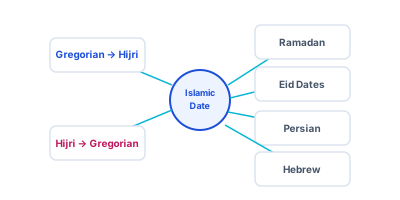
The homepage focuses on the two core conversion directions most people need: Gregorian to Hijri and Hijri to Gregorian. Dedicated links below the tool open focused pages for Ramadan ranges, Eid dates, Persian calendar conversion, Hebrew calendar conversion, and date calculators.

Gregorian to Hijri

Enter a Gregorian date with the date picker and return the matching Islamic civil year, month, day, and Hijri month name.

This direction is useful when your source material uses the common civil calendar but you need a Hijri reference beside it. The result is especially helpful for records, content drafts, and side-by-side calendar tables where every lookup should remain repeatable.

Hijri to Gregorian

Enter a Hijri date in YYYY-MM-DD format and convert that civil Hijri date back into the Gregorian calendar.

Use this direction when an archive, note, family record, or Islamic calendar reference gives the Hijri date first. The converter validates the numeric month and day against the civil Hijri calendar before returning the Gregorian equivalent.

Repeatable civil basis

The conversion uses deterministic arithmetic rules, so results are stable across requests and suitable for repeatable references.

That stability is different from an official observance calendar, which may respond to local announcements or crescent-sighting decisions. The homepage therefore works best as a civil conversion reference rather than a final authority for worship schedules.

How to use

How to convert an Islamic date

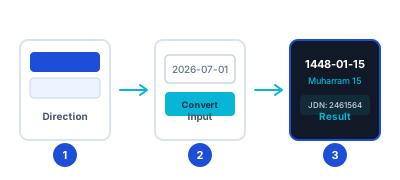
Choose the direction that matches the date you already have. You only need one source date for each conversion; the result panel shows the converted date and the reference Julian Day Number used internally.

1

Choose the direction

Select Gregorian to Hijri for a standard Gregorian date, or Hijri to Gregorian when your source value is already an Islamic civil date.

Choosing the direction first keeps the form simple because each calendar has different validation rules. Gregorian input uses the browser date field, while Hijri input is typed as a numeric civil date.

2

Enter one date

Gregorian input uses YYYY-MM-DD from the date picker. Hijri input should also use YYYY-MM-DD, such as 1448-01-15.

Use numeric months rather than month names so the calculation can validate the date directly. If the day does not exist in that civil Hijri month, the form returns an error instead of guessing.

3

Check the calendar basis

Use the output as an Islamic civil calendar result. For religious observance, compare it with the moon-sighting or official calendar authority used in your location.

This distinction matters most near the start of lunar months, Ramadan, Eid, and local holidays. A civil result can be accurate for this arithmetic model while still differing from a community announcement.

Use cases

Practical ways to use civil Hijri conversion

A deterministic Islamic date converter is most useful when consistency matters more than local observation. The same date can be converted again later and still produce the same civil result.

Record keeping

Add Hijri equivalents beside Gregorian dates in spreadsheets, database exports, family records, forms, or internal reference tables.

Because the converter is deterministic, the same record can be checked again later without depending on a changing regional calendar source. That makes the output practical for annotations and audit trails where consistency is more important than local observance policy.

Software and QA

Create repeatable conversion examples for test fixtures, date normalization code, import tools, and cross-calendar user interfaces.

The Julian Day Number shown in results gives developers a neutral day reference to compare both directions. It also helps catch off-by-one errors when a separate system uses a different Hijri calendar assumption.

Calendar comparison

Compare civil Hijri results with local official calendars to understand where observation-based or authority-based calendars shift by a day.

This is useful when preparing content for audiences in more than one region. You can start with the civil conversion, then note where a national or community calendar announces a different date.

Examples

Islamic Date Converter examples

These examples show the input format and the kind of output produced by the same local conversion functions used by the form.

Gregorian date to Hijri date

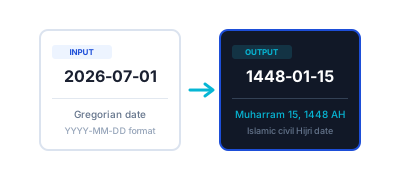
2026-07-01 -> 1448-01-15 AH

The Gregorian date 2026-07-01 converts to Muharram 15, 1448 AH in this civil calculation.

This example shows the normal homepage direction: start with a Gregorian date, then read the numeric Hijri date and month label from the result panel.

Hijri date to Gregorian date

1448-01-15 AH -> 2026-07-01

The civil Hijri input 1448-01-15 converts back to Gregorian 2026-07-01.

The reverse example confirms that both directions share the same day-count basis. It is a useful sanity check when comparing imported Hijri dates with Gregorian records.

Date format example

YYYY-MM-DD

Use four or more digits for the year, two digits for the month, and two digits for the day. Hijri month values must be 01 through 12.

Keeping the same numeric pattern for both calendars reduces ambiguity. The page does not parse month names, regional spelling variants, or partial dates.

Ramadan civil range example

1448 AH -> 2027-02-08 to 2027-03-09

The Ramadan page maps month 09 of a Hijri year to a Gregorian start and end range using the same civil arithmetic.

Use the range as a planning reference, then check the official calendar for the country or community involved before publishing fasting or event dates.

Persian Solar Hijri example

2026-07-01 -> 1405-04-10 SH

The Persian converter is a solar calendar tool, separate from Islamic lunar Hijri conversion.

It is included because many users compare several regional calendars at once, but its year, month lengths, and leap-year pattern are not the same as Islamic Hijri.

Hebrew calendar example

2026-07-01 -> 5786-10-16 AM

The Hebrew converter uses Tishri-first numeric month input and shows the Hebrew month label in the result.

This keeps Hebrew date lookup predictable for numeric input, including leap-year cases where month names and numbering need careful attention.


Limitations

What this converter is not designed to decide

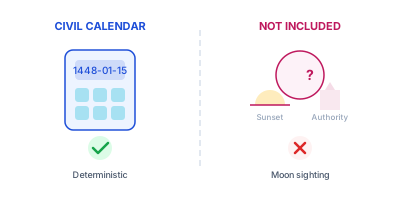
Calendar conversion and religious observance are related, but they are not the same task. This site gives deterministic civil calendar results; it does not replace local authorities, observation committees, or sunset-aware timing tools.

Not a moon-sighting report

The converter does not inspect crescent visibility, weather, horizon conditions, or testimony. It uses arithmetic calendar rules only.

That makes the result fast and repeatable, but it also means the tool cannot answer whether a crescent was actually sighted in a particular place on a particular evening.

Not a local observance calendar

Communities and countries may announce Ramadan, Eid, and other dates according to their own official process.

If a date will be used in public notices, school calendars, travel plans, or religious programming, confirm it with the relevant local authority before treating it as final.

Not a sunset-time calculator

The tool works with whole calendar dates and does not calculate local sunset transitions, prayer times, or halachic time boundaries.

For calendars where a day begins at sunset, a local time tool or authoritative calendar may be needed in addition to this date conversion reference.

FAQ

Islamic date conversion questions

What is an Islamic Date Converter?

An Islamic Date Converter changes a Gregorian calendar date into a Hijri calendar date, and can also convert a Hijri civil date back into Gregorian format.

This site focuses on the civil arithmetic Hijri calendar, so it is best used for stable lookup and comparison. It helps you translate date labels between calendars without changing the underlying historical or planning record.

Is this based on moon sighting?

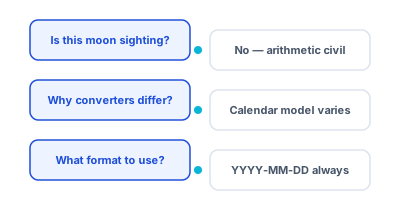
No. It uses an arithmetic Islamic civil calendar so the same input always returns the same output. Local moon-sighting calendars can differ.

Moon-sighting practice depends on location, weather, testimony, and the authority making the announcement. Those factors are intentionally outside this converter so the result remains deterministic.

Why can Hijri converters disagree?

Different tools may use civil arithmetic rules, astronomical visibility models, Umm al-Qura-style official calendars, or local religious announcements. This tool states its civil basis explicitly.

When two converters differ by one day, the difference is often caused by the calendar model rather than a simple bug. Check the method each site claims before deciding which result fits your purpose.

What input formats are accepted?

Gregorian input comes from the date field. Hijri input uses YYYY-MM-DD text format, with valid month and day values for the civil Hijri calendar.

The converter expects complete dates because partial dates can map to many possible days. Enter the year, month, and day together to get a specific conversion result.

Does the converter use my time zone?

No. It converts whole calendar dates. It does not shift results based on browser time zone, local sunset, or time of day.

This avoids hidden changes when the same page is opened from different locations. If your use case depends on sunset or local day boundaries, pair the result with a location-aware calendar source.

Why include Persian and Hebrew converters?

They support adjacent calendar lookup needs, but they use different calendar systems. Persian Solar Hijri is solar, Hebrew is lunisolar, and Islamic civil Hijri is lunar arithmetic.

Keeping these tools together helps users compare dates across several calendar traditions while still making clear that each converter follows its own rules.

Can I use results in published material?

Yes, but label the calendar basis. For Hijri results, note that the value is from an arithmetic Islamic civil calendar, not a local moon-sighting calendar.

A short basis note prevents readers from assuming the date is an official announcement. This is especially important for Ramadan, Eid, and other dates where public observance may vary.

What should I do for official holidays?

Use the converter as a reference, then confirm final holiday or observance dates with the official body responsible for your location.

Official dates can depend on national calendars, local committees, or announcements made close to the event. The civil result is a useful starting point, not a substitute for that confirmation.

Reference

Civil Hijri conversion reference notes

The Islamic civil calendar used here follows a repeatable 30-year leap-year cycle with alternating 30-day and 29-day months, adjusted for leap years in Dhu al-Hijjah. The converter maps both directions through a Julian Day Number so the same day reference is used consistently.

For official event dates, holidays, fasting starts, or worship planning, always compare the civil result with the authority responsible for your community or jurisdiction.